Purchase a print or digital copy
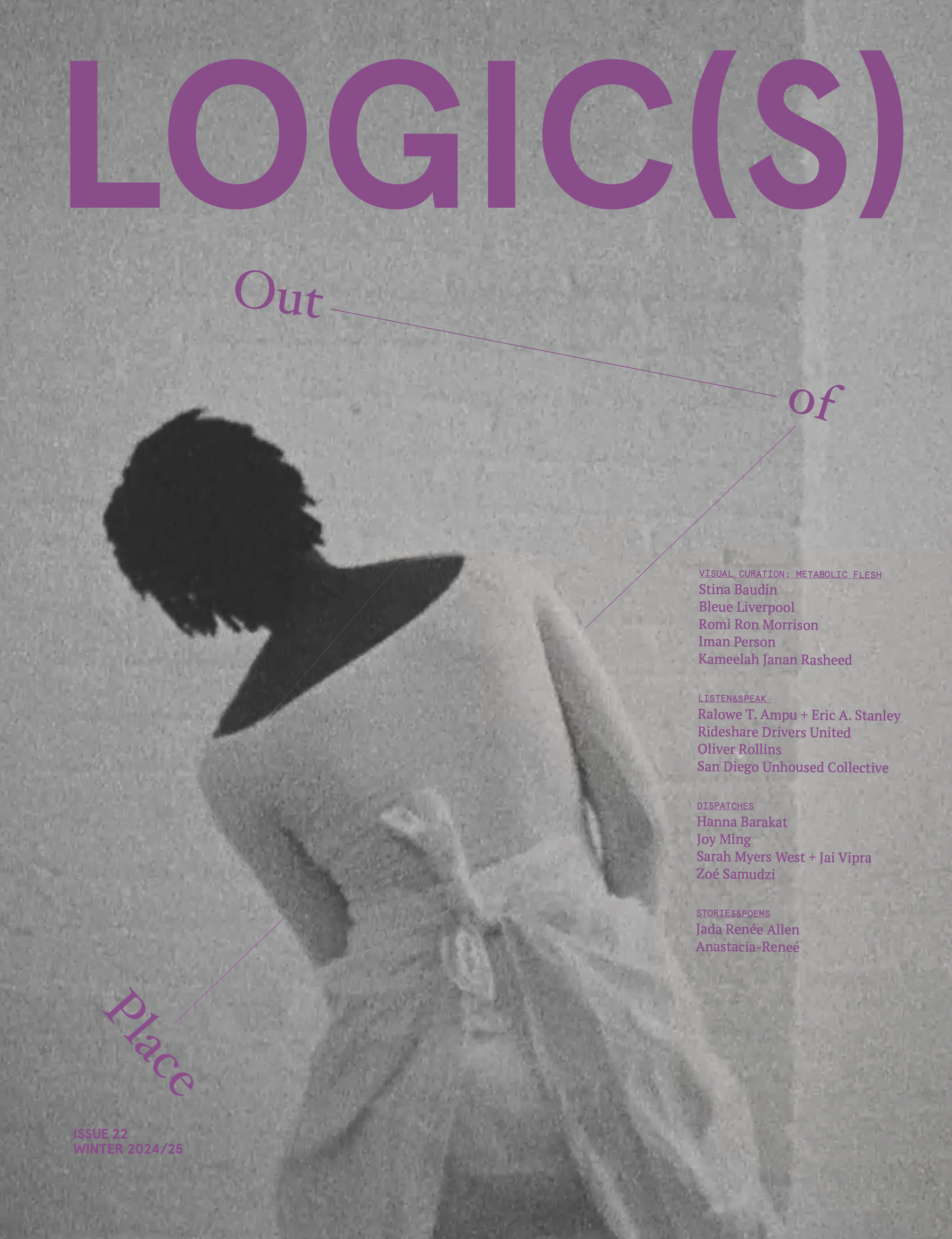
Out of Place
Viewing technology in the longue durée foregrounds how slavery undergirds conditions of contemporary extraction, surveillance, and the insistence on positing knowledge as outside of those arrangements—practices that produce today’s technologies. Contributors to this issue of Logic(s), “Out of Place,” challenge the logic that racism is contaminating and disabling the pure disembodied model, or that race is principally a site for enumerating harms that can be subsequently extinguished.
Rather, the analysis throughout these pages underscores how race is constitutive of how models are developed and deployed. Beyond this, the vulnerability to premature death that digital infrastructures enable, is due to the ways those of us rendered out of place are disciplined into the flows of projected outcomes—or, if noncompliant, wholly removed from the dataset (and society).
Editor’s Letter: Out of Place
An introduction to issue 22 by Editor in Chief J. Khadijah Abdurahman
in the coherence, we weep
A series of prints exploring the critical potential of incoherencies through mapping methodologies across media, opening glitches that allow for moments of critical self-reflection and knowledge production.
Poems Are Also Spells: A Conversation with Jada Renée Allen
On dark-skinned Black femme abolitionist poetics
Rideshare Drivers United versus the Prop 22 Consensus with Nicole Moore and Alvaro Bolainez
Reflections on the organization’s organizing tactics in the years since California’s passage of Proposition 22
Psychopathic Imaging: Linking Brain Scans to Criminal Behavior with Oliver Rollins
A critical dialogue on the use of functional MRI for determining criminal pathology and the eugenic preconditions of neuroscience research
Mapping Black Dispossession in San Francisco with Ralowe T. Ampu and Eric A. Stanley
Insights from abolitionist organizing on the implications of computation in municipal projects of mass displacement in San Francisco
Trees, Trade, and Text Messages: Scenes from a Palestinian Spatial Politic
Linking her uncle’s agricultural methods in the diaspora to informal networks of mutual support in Palestine, Barakat draws out attention to an Indigenous Palestinian present.
To Resist Annihilation: Paternity, Inheritance, and Love against Surveillance Medicine
On surveillance medicine’s capacity to entrench the biological family as a site for monitoring and premature death. Samudzi thoughtfully reflects on her personal fallout following her father’s cancer diagnosis to the broader bio-surveillance of Palestinian life under genocide and occupation.